

Review of Data Science from Scratch
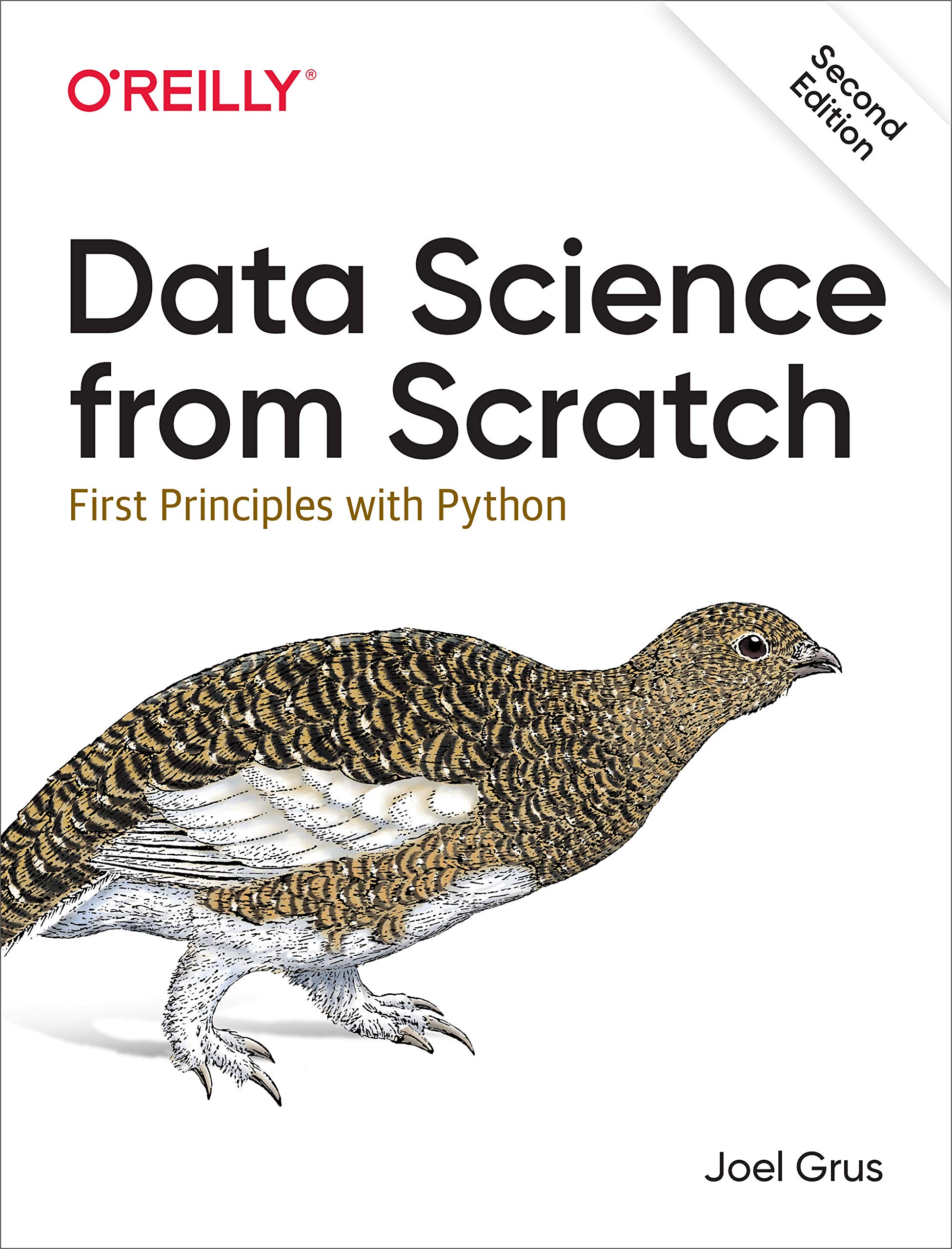
The following is a review of the book Data Science from Scratch by Joel Grus.
This Data Science from Scratch review is for readers who can write basic Python and want to understand what algorithms calculate. Its strength is implementing ideas directly; it is a slower route if your immediate goal is to train a model with a library.
Planning to use Python for machine learning? Read the free Starter Kit excerpt on test sets before your first model. No email required; the full Starter Kit costs €19.
This review covers the second edition. Use the author’s companion repository for the matching code and examples, and check its instructions when setting up your environment.
We will begin by clarifying who this book is for: it is for people with at least some sort of programming knowledge in Python, and some basic algebra and statistics knowledge. If you are not there yet, take a look at our awesome recommended Python Programming books, and our Statistics and probability courses. If you meet the above pre-requisites, and want to learn Data Science from a basic level then you will love this book.
The author does a great job explaining the topics and introducing little pinches of humor every now and then to keep the reading entertaining, even in the most complex topics. If you are considering going into Machine Learning and Data Science, this book is a great first step.
It will teach you the most fundamental data science concepts, encouraging you to write simple functions of code so that you really learn what is happening under the hood of the most popular Python Data Science libraries like Numpy, Pandas and Scikit Learn.
Writing a small implementation can expose assumptions that a library call hides. It also takes time: test each function on a tiny example whose answer you can calculate by hand, then compare it with an established library.
It is a really pedagogical book, and a great read to develop an strong understanding of the fundamental concepts necessary to understand data science and machine learning.
Stay on track. Get the Roadmap.
Download the 90-Day Roadmap PDF + get weekly tips and resources to help you succeed
Book Description and Contents
To really learn data science, you should not only master the tools—data science libraries, frameworks, modules, and toolkits—but also understand the ideas and principles underlying them. Updated for Python 3.6, this second edition of Data Science from Scratch shows you how these tools and algorithms work by implementing them from scratch.
If you have an aptitude for mathematics and some programming skills, author Joel Grus will help you get comfortable with the math and statistics at the core of data science, and with the hacking skills you need to get started as a data scientist. Packed with New material on deep learning, statistics, and natural language processing, this updated book shows you how to find the gems in today’s messy glut of data.
- Get a crash course in Python
- Learn the basics of linear algebra, statistics, and probability—and how and when they’re used in data science
- Collect, explore, clean, munge, and manipulate data
- Dive into the fundamentals of machine learning
- Implement models such as k-nearest neighbors, Naïve Bayes, linear and logistic regression, decision trees, neural networks, and clustering
- Explore recommender systems, natural language processing, network analysis, MapReduce, and databases.
See the publisher’s second-edition contents and the official code repository. The video below discusses an earlier edition, so its chapter details may differ.
About the book
Joel Grus is the author of Data Science from Scratch. His companion code is useful alongside the book: read an implementation, reproduce it on a small dataset, and write tests for edge cases before moving on.
Pages: 406 pages
Publication: First publication 2015, Second Publication 2019
Summary of Data Science from Scratch
Expect to pause for the mathematics and to debug your own implementations. If functions, comprehensions, or basic algebra still feel unfamiliar, spend time on those prerequisites before tackling the machine-learning chapters.
The payoff is a more concrete understanding of how a method works. For production projects, use maintained libraries and validate their behavior rather than assuming an educational implementation is ready to deploy.
As for the actual content of this book, it is fascinating and useful. If you’re looking for a concise introduction to data science and have a bit of knowledge of basic Python, algebra, statistics and probability, look no further than this book!
A useful follow-up is to fit the same simple regression with your implementation and a library, then compare predictions on held-out data. Our guide to evaluating machine-learning models explains why training performance alone is insufficient.
For more reviews like this one, check out our Machine Learning books category!
Thank you very much for reading How to Learn Machine Learning and have an awesome day!
Tags: Data Science, Machine Learning, Data Science for Beginners, Machine Learning for beginners.
Subscribe to our awesome newsletter to get the best content on your journey to learn Machine Learning, including some exclusive free goodies!
