
Hello dear Friend, and welcome again to How to Learn Machine Learning!
In this article we will speak about the technical blueprint from a flawless MLM.
Introduction
Here’s something you won’t find in typical binary mlm software reviews: The architectural decisions embedded in your MLM software platform will determine your company’s technical scalability for the next 5-10 years.
I’m Alex Rivera, and as a systems architect who has worked with FlawlessMLM on dozens of network marketing platform implementations, I’ve seen firsthand how technical debt in mlm software development choices creates hard ceilings on growth that only become apparent when it’s too late to pivot gracefully.
Most founders evaluating MLM software price tags or reading binary mlm software companies marketing materials focus on features and front-end interfaces.
They’re missing the critical layer: the technical architecture that determines whether their platform will scale from hundreds to hundreds of thousands of distributors without performance degradation or costly rewrites.
This is particularly crucial when implementing structured plans like a forced matrix mlm software system, where database design directly impacts calculation speed and user experience.
Modern MLM platform architecture: Layered design separating data, business logic, and presentation for optimal scalability.
The Database Dilemma: Genealogy Trees vs. Performance
Technical Reality: Most low cost mlm software platforms use simple relational database structures that work fine at small scale but become exponentially slower as your organization grows. When your binary tree hits 10,000+ nodes or your matrix fills multiple levels deep, inefficient queries can turn commission runs into multi-hour processes.
Binary Plan Database Challenges
Binary mlm software that implements true spill over binary mlm software mechanics needs to efficiently traverse and balance two-legged trees.
The naive approach—storing parent-child relationships in a simple table—leads to recursive queries that grow increasingly expensive. At scale, calculating matching bonuses across wide, deep binary structures requires specialized indexing strategies and sometimes graph database approaches.
Matrix Plan Performance Considerations
For matrix mlm software platforms, particularly those implementing structured plans like a forced matrix mlm software system, the challenge is different but equally critical. Matrix plans with fixed dimensions (3×7, 4×12, etc.) create predictable but dense relationship networks.
Efficient systems pre-calculate position assignments and use bitmask operations for status tracking, while poorly architected ones perform expensive row-by-row calculations during every commission run.
Performance Red Flag: If a vendor cannot explain their database strategy for handling 100,000+ distributor genealogy with sub-second query times for common operations (finding upline, calculating team volume), you’re looking at future scalability problems.
Microservices vs. Monolith: The Integration Equation
The debate between microservices architecture and monolithic design isn’t academic—it directly impacts your ability to integrate with other systems, deploy updates, and scale individual components of your MLM software solution.
Monolithic Architecture
Traditional approach where mlm commission software, mlm crm, and mlm ecommerce software are tightly coupled. Simpler to deploy initially but creates challenges when you need to:
- Update one component without risking the entire system
- Scale the commission engine separately from the web front-end
- Integrate with third-party payment processors or analytics tools
Microservices Approach
Modern architecture where each functional component (compensation engine, e-commerce, CRM, reporting) operates as independent services. This provides:
- Independent scaling of high-demand components
- Faster deployment of individual feature updates
- Easier integration with external systems via API gateways
- Resilience – one service failure doesn’t crash the entire platform
At FlawlessMLM, we’ve migrated multiple clients from monolithic Network Marketing MLM Software platforms to microservices architectures. The transformation typically reduces commission calculation times by 60-80% while improving system reliability. However, this architectural sophistication contributes to the real mlm software price that delivers long-term value versus short-term savings.
Caching Strategy: The Secret to Real-Time Performance
When distributors check their dashboard, they expect real-time data. When leaders view team performance, they want current numbers. This expectation creates immense pressure on your network marketing commission software backend. The solution isn’t faster hardware—it’s intelligent caching.
Multi-Layer Caching Architecture
- User Session Cache: Stores frequently accessed personal data (recent commissions, team snapshot)
- Genealogy Cache: Pre-calculated team structures and volumes for rapid dashboard loading
- Commission Calculation Cache: Intermediate calculation results that can be reused across similar distributor scenarios
- CDN for Static Assets: Fast delivery of mlm website images, scripts, and styles globally
OperationWithout CachingWith Intelligent CachingPerformance GainDistributor Dashboard Load2-5 seconds200-500ms10x fasterTeam Volume Calculation3-8 seconds300-800ms8-10x fasterCommission Run (1000 distributors)45-90 minutes5-15 minutes6-9x fasterGenealogy Tree Display4-7 seconds400-700ms10x faster
Implementation Insight: Effective caching isn’t just about speed—it’s about consistency. When implementing systems like a forced matrix mlm software plan, cache invalidation strategies become critical. You need to know precisely when to clear and rebuild cached data to ensure distributors always see accurate, current information despite the performance optimizations.
API-First Design: The Integration Foundation
Your MLM Multi Level Marketing Software doesn’t exist in a vacuum. It needs to connect with payment gateways, email services, SMS providers, analytics platforms, and potentially dozens of other tools. An API-first design approach ensures these integrations are sustainable rather than fragile.
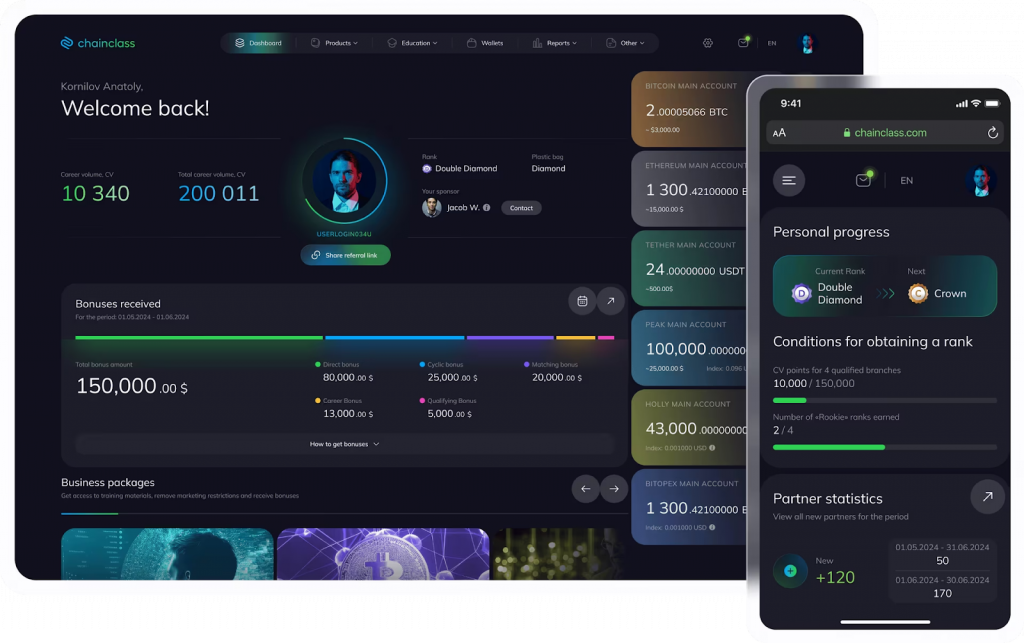
What API-First Really Means
- Comprehensive API Documentation: Not just endpoint lists, but interactive documentation (OpenAPI/Swagger) that developers can test against
- Versioned APIs: The ability to update system functionality without breaking existing integrations
- Webhook Support: Real-time event notifications for critical actions (new signup, sale, commission payment)
- Rate Limiting & Authentication: Enterprise-grade security for API access
When evaluating Best Network Marketing Software options, ask to see their API documentation. If they can’t provide comprehensive, developer-friendly APIs, you’re likely looking at a platform that will create integration headaches as you grow. This becomes especially important when your mlm marketing tool ecosystem expands to include specialized analytics, mobile apps, or international payment processors.
The Cloud Infrastructure Decision
Gone are the days of self-hosted mlm software development solutions running on single servers. Modern platforms leverage cloud infrastructure for elasticity, reliability, and geographic distribution. But not all cloud implementations are equal.
Architecture Warning: “Cloud-hosted” doesn’t automatically mean “cloud-architected.” Some binary mlm software companies software simply runs traditional monolithic applications on cloud virtual machines, missing the benefits of true cloud-native design like auto-scaling, managed databases, and serverless components.
True Cloud-Native Characteristics
- Auto-scaling: The system automatically adds resources during peak loads (month-end commission runs, product launches)
- Multi-region Deployment: Distributors in Asia, Europe, and the Americas experience similar performance
- Managed Services: Using cloud provider databases, caching, and queue services rather than self-managed equivalents
- Infrastructure as Code: The entire deployment is defined in code for consistency and repeatability
These architectural choices directly impact the reliability your distributors experience and the operational burden on your team. They also influence the true mlm website price when considering support and maintenance costs over a 3-5 year horizon.
Architectural Due Diligence: Your Technical Checklist
When you’re ready to Buy Best Mlm Software for your organization, move beyond feature checklists and ask the architectural questions that will determine your long-term scalability:
- Database Architecture: How does the platform handle genealogy queries at scale? Ask for performance benchmarks with 50,000+ simulated distributors.
- Caching Strategy: What layers of caching are implemented, and how is cache invalidation handled to ensure data consistency?
- API Maturity: Review the API documentation. Is it comprehensive, versioned, and developer-friendly?
- Deployment Approach: Is this true cloud-native architecture or just cloud-hosted traditional architecture?
- Disaster Recovery: What is the RTO (Recovery Time Objective) and RPO (Recovery Point Objective) for critical systems?
- Technical Roadmap: How does the vendor plan to evolve the architecture over the next 2-3 years?
The most successful network marketing companies I’ve worked with treat their Network Marketing Software Mlm platform as a strategic technical asset, not just a business tool. They understand that architectural decisions made today will either enable exponential growth or create painful technical debt that must be paid with interest later.
When architecture aligns with ambition, technology becomes an accelerant rather than a constraint. Your platform should feel like it’s working with you, not against you, as you scale from hundreds to hundreds of thousands of distributors worldwide.
Alex Rivera is a systems architect specializing in high-scale distributed systems. With over 12 years in platform architecture, he focuses on the intersection of technical design and business growth requirements for direct sales organizations.
About the Technical Analyst
Alex Rivera brings a unique combination of computer science expertise and business process understanding to network marketing technology. His work focuses on helping organizations avoid architectural pitfalls that limit growth while maximizing the technical leverage they gain from their software investments.
© 2025. This technical analysis represents architectural patterns observed across multiple MLM platform implementations. Specific performance characteristics will vary based on implementation details, scale, and usage patterns.
As always, thank you so much for reading How to Learn Machine Learning and have a wonderful day!
Subscribe to our awesome newsletter to get the best content on your journey to learn Machine Learning, including some exclusive free goodies!