

The logistics industry is changing as a result of machine learning, which is also changing how businesses operate, plan, and deliver.
Logistics companies can process enormous amounts of operational data, find useful insights, predict demand swings, minimize bottlenecks throughout distribution networks, and provide more consistent customer experiences by utilizing sophisticated algorithms.
Because of this, machine-learning-driven solutions are now essential to contemporary logistics strategies meant to improve overall performance and efficiency.
What Does Logistics Machine Learning Entail?
Machine learning in supply chain management and logistics refers to the application of self-improving computational models that evaluate past and present data to optimize logistics operations without the use of hard-coded rules.
Transportation systems, warehouses, IoT-enabled devices, ERP platforms, and customer interaction channels are just a few of the data sources from which these models find patterns and trends.
Machine learning allows for more intelligent decision-making and flexible logistics procedures by continuously learning from this data.
Important Logistics Use Cases for Machine Learning
Throughout the whole logistics value chain, machine learning is used to support both daily operations and strategic planning.
Fraud Detection & Risk Management
With machine learning, it is possible for logistic providers to identify abnormal shipment data, billing records and delivery confirmations. This process allows logistic providers to detect fraudulent activities, minimise losses and comply with contractual and regulatory requirements.
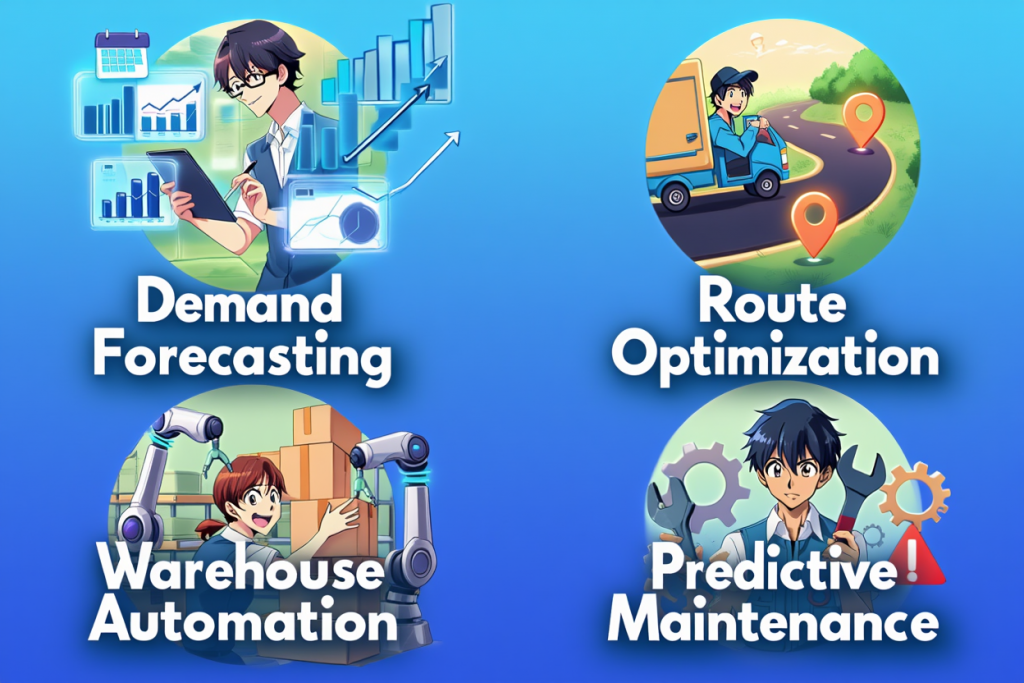
Inventory Optimization and Demand Forecasting
In order to create a well-informed forecast for future sales and optimize inventory levels based on those forecasts, machine learning algorithms examine historical sales data (seasonal trends, market conditions, and external factors).
Logistic teams can optimize the quantity of inventory kept in warehouses (or distribution centers), minimize out-of-stock situations, and eventually reduce excess inventory.
Route Optimisation & Transportation Planning
By analyzing data on traffic conditions, fuel consumption, customer delivery windows, and delivery performance metrics, carriers can use machine learning to optimize their routes. ML can update routes during transportation based on fresh data in real-time, in addition to enhancing deliveries in the future. This helps cut down on fuel expenses, carbon emissions, and the time required for upcoming deliveries.
Optimising Warehouse Layout Through Automated Slotting
Warehouse automation uses ML to identify the most efficient way to layout inventory using data regarding how frequently items will be picked and delivered, item dimensions, etc. Further ML is used to improve object identification and task prioritization of robotic and automated systems, and for workforce planning.
Predictive Maintenance of Fleet and Equipment
As vehicles and warehouse equipment are monitored via sensors, the data collected will allow ML models to predict when they may experience failure. Predictive maintenance reduces unplanned downtime, extends the life of assets and reduces maintenance costs.
Benefits and Challenges of Machine Learning for Logistics Companies
The implementation of machine learning provides numerous benefits to logistics organizations in the following ways:
- Increased Efficiency in Operations – Machine Learning enables organizations to automate repetitive processes and optimize resource usage.
- Decreased Costs – Through the reduction of fuel consumption, lower levels of inventory, and fewer instances of delivery failures.
- Improved Planning and Decision Making – The availability of real-time data and information allows for more effective and quicker planning processes.
- Improved Customer Experience – More timely and dependable deliveries lead to higher levels of customer satisfaction and increased loyalty.
- Greater Resilience Within Supply Chain – Machine Learning assists organizations in preparing for potential disruptions to the supply chain, as well as assisting in the ability to implement a proactive response.
Even though there are many positive aspects to using Machine Learning in Logistics, there are also a number of challenges faced when implementing the technology:
- The quality and availability of data – In many cases, logistics-related information exists on many systems (often), which means that it cannot easily be combined/cleaned up for use with an ML model.
- Integration with existing systems – Many of the technologies being used today are very dated or simply don’t work well together, creating another barrier to using this technology.
- In-house expertise – Most organizations will rely primarily on external companies to help with implementing and maintaining Machine Learning systems because they do not have enough internal expertise to be successful.
- Continued Monitoring of Models – Once a Machine Learning model is built, it needs to be monitored continuously to ensure it does not become biased, lose performance, or make poor predictions.
How to Implement Machine Learning in Logistics
When implementing machine learning in the logistics industry, an organization should take a systematic approach that starts with clearly defined business objectives and then works backward to the business’s operational data.
Clearly Defining Your Business Objectives
Machine learning and data science initiatives should always start with clearly defined business objectives. For example, an organization may have issues with inaccurate forecasting, high costs associated with transportation, or inefficiencies in warehousing and storage. A clearly defined objective will help an organization determine what type of machine learning models to utilize, as well as how to measure success.
Consolidating the Logistics Data
To create machine learning models that will provide meaningful results, it is critical for an organization to have quality data from many different sources, including TMS (Transportation Management System), WMS (Warehouse Management System), ERP (Enterprise Resource Planning), IoT (Internet of Things) sensors, and customer related systems. All of the data must be cleaned, standardized, and consolidated prior to using it to train a machine learning model.
Selecting the Appropriate Machine Learning Models
Depending on the use case for machine learning in logistics, an organization will likely need to use different machine learning models.
Demand forecasting is typically done using time-series models, route optimization is typically done using optimization algorithms, and identifying risk or equipment failure would typically require the use of anomaly detection models. When selecting a machine learning model to solve a particular business need, it is essential to align the machine learning model to both the data to be used to train the machine learning model and the business objectives.
Combine Machine Learning with Established Systems
To derive real benefit from Machine Learning solutions, they should be integrated into existing supply chain infrastructure seamlessly.
This might be done through the application of software tools such as transportation management systems (TMS), warehouse management systems (WMS), fleet tracking applications, or analytical dashboards. By having effective integration between ML and existing applications, businesses can make real-time decisions and automate processes.
Train, Test, and Validate Models
Prior to being deployed into production, Machine Learning models need to undergo a training process to establish an understanding of the historical data, and to verify their effectiveness through testing against the current marketplace.
The validation process will confirm that your model accuracy, reliability and robustness exists in the real world; especially during seasonal fluctuations, demand peaks, and unplanned events.
Continuously Monitor and Improve Performance
Continuous monitoring of performance is necessary for Machine Learning models, due to the dynamics of an ever-evolving supply chain; in order to keep pace with changing conditions, you must re-train the model using more current data, in order to continue to have an accurate model.
LMS/Ongoing optimization also assures that your Machine Learning solutions will continue to scale and achieve long-term success.
Machine Learning’s Prospects in Logistics
Machine learning will become a more strategic tool as logistics networks grow more complex. The use of ML alongside generative AI, digital twins, and autonomous systems, supported by professional gen AI development services, will allow for predictive, self-optimizing supply chains.
Businesses can build supply chains that are more flexible, scalable, and customer-focused than those of their rivals by investing in machine learning today.s.
As always, thank you for reading How to Learn Machine Learning and have a great day!
Subscribe to our awesome newsletter to get the best content on your journey to learn Machine Learning, including some exclusive free goodies!
