

Manifold learning: what it does and when to use it
Manifold learning looks for a lower-dimensional representation of data whose structure may be nonlinear. It is useful for exploring high-dimensional measurements, but a convincing 2D picture does not prove that natural clusters exist.
A practical first experiment: compare a PCA projection with a nonlinear method on the same scaled features. Repeat with several settings and random seeds. Check whether conclusions remain stable before interpreting groups or outliers.
For prediction, compare against a baseline without dimensionality reduction using the same validation splits. Fit preprocessing only on training data; see our cross-validation guide.
Build a sound ML workflow. Read the free Starter Kit excerpt on test sets to preview the €19 handbook. No email required.
In this article, we’re diving into one of the most fascinating—and often misunderstood—areas of modern Machine Learning: Manifold Learning.
If you’ve ever wondered how algorithms “unwrap” complex, high-dimensional data into meaningful low-dimensional structures… you’re about to find out!
1. Introduction: What Is Manifold Learning?
We live in a world full of high-dimensional data: images, sounds, text embeddings, sensor readings, gene sequences—everywhere you look, the dimensions explode.
But here’s a secret: Even though the data lives in high-dimensional space, its true structure is often low-dimensional.
This low-dimensional structure is called a manifold, and manifold learning refers to the set of algorithms that try to uncover this hidden structure.
Think of it like:
- Flattening a crumpled sheet of paper
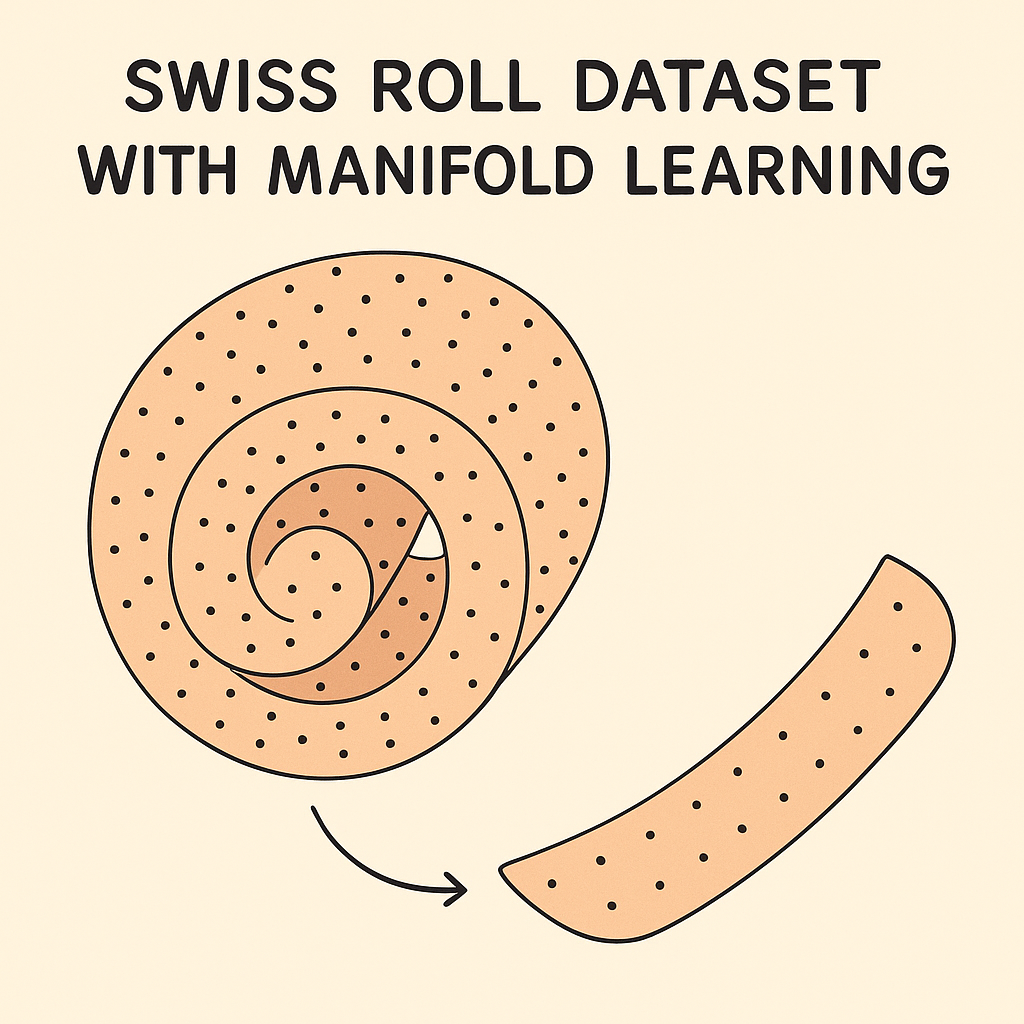
- Unfolding a Swiss roll
- Discovering that a huge dataset really lies on a simple curve or surface
Manifold learning is a cornerstone technique in ML for:
- Dimensionality reduction
- Visualization
- Preprocessing for clustering or classification
- Understanding embeddings in Deep Learning
It’s math, geometry, and intuition all mixed together—ML magic.
2. Why Manifold Learning Matters
Manifold learning allows us to do many things. Here we will list the most important ones.
2.1. Visualize Data in 2D or 3D
Tools like t-SNE and UMAP help reveal clusters, anomalies, and relationships.
2.2. Improve Model Performance
Dimensionality reduction can suppress noise, but it can also discard predictive information. Measure its effect on held-out data rather than assuming an improvement.
As with other Dim reduction techniques, specially useful for models that calculate some sort of distance metric, Manifold Learning allow us to reduce noise and simplify the models.
2.3. Discover Hidden Structure
High-dimensional data rarely lies everywhere. Manifold learning finds where the structure actually is.
2. 4. Power Deep Learning Embeddings
Word embeddings (find super cool article here), image embeddings, and latent spaces are all built on manifold ideas.
3. Popular Manifold Learning Algorithms
Principal Component Analysis (PCA)
PCA is a linear dimensionality-reduction baseline: it finds orthogonal directions of maximum variance in centered data. It is usually distinguished from nonlinear manifold-learning methods such as Isomap and LLE.
It assumes the data lies on a linear subspace (a flat manifold).
PCA can be a useful fast baseline, but a linear projection cannot generally unfold a nonlinear manifold.
3.2 Isomap
Captures geodesic distances—the distances along the manifold.
Perfect for “unfolding” curved surfaces like the famous Swiss roll dataset.
3.3 Locally Linear Embedding (LLE)
LLE assumes that each small neighborhood of points is approximately flat.
It preserves local relationships, making it great for:
- Motion data
- Sensor data
- Face images with varying pose
3.4 t-SNE
The king of visualizations. I don’t really love it because aside from visualizing its not great for anything else – In a traditional ML pipeline you will most likely use PCA to reduce Dims, and not t-SNE.
t-SNE emphasizes local similarities. Apparent cluster sizes, gaps, and global distances can be misleading; repeat the analysis with different settings before drawing conclusions.
3.5 UMAP (Uniform Manifold Approximation and Projection)
A more modern alternative to t-SNE:
- Runtime depends on the dataset, implementation, and settings
- Global relationships still require careful validation
- Excellent for embedding exploration
UMAP is widely used in NLP, bioinformatics, and deep learning interpretability. Much preferred.
4. Real-World Applications of Manifold Learning
Bioinformatics
Analyzing gene expressions, cell transcription states, and other high-dimensional biological signals.
Deep Learning
Understanding latent spaces in autoencoders, GANs, and diffusion models.
Image Recognition
Faces under different lighting conditions lie on smooth manifolds—perfect for manifold methods.
Speech Processing
Vocal tract configurations form low-dimensional shapes, even if the raw audio looks high-dimensional.
5. A Simple Intuition: The Swiss Roll Story
Imagine taking a long strip of paper and rolling it up into a spiral.
Although the data appears complex in 3D, the true structure is just a 2D sheet.
Manifold learning algorithms try to:
👉 Recover the original 2D sheet without tearing or stretching it.
This is the heart of manifold learning.
Some Cool links here
Summary: Why You Should Care About Manifold Learning
Manifold Learning is the bridge between raw high-dimensional chaos and beautifully organized low-dimensional structure. Whether you’re visualizing embeddings, uncovering hidden patterns, or preprocessing data for your models…
Manifold learning provides a representation to investigate, not proof of the dataset’s true geometry.
It’s powerful, elegant, and surprisingly intuitive once you see it in action.
As always thank you so much for reading How to Learn Machine Learning, and have a wonderful day!

Stay on track. Get the Roadmap.
Download the 90-Day Roadmap PDF + get weekly tips and resources to help you succeed
Subscribe to our awesome newsletter to get the best content on your journey to learn Machine Learning, including some exclusive free goodies!
